
A special thank you to AlgaeBarn for donating phytoplankton, copepods, and macroalgae that made this hands-on lab possible. Their contribution allowed students to explore real marine organisms up close and experience the excitement of discovery through direct observation.
Exploring the Microscopic World
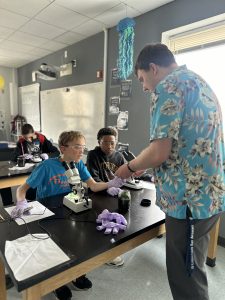 Mr. Snyder’s middle school scientists explored the microscopic world with hands-on stations using two types of microscopes: compound scopes for detailed cellular views and dissection scopes for a broader look.
Their mission: to observe, describe, and draw what they saw. They examined algae, zooplankton, and phytoplankton—some tiny enough to be tricky to find—and compared how each organism looked under each microscope. Gloves on, they were encouraged to touch and interact with the algae that was generously donated for the lab.
Students described colors, shapes, and textures, and even picked favorites among the specimens. The focus wasn’t just on seeing—it was on using descriptive language, making observations, and connecting what they saw under the microscope to the world around them.
By the end, every student had discovered something new and surprising, proving that science is best learned when you can see, touch, and explore.


